“BLACK WARRIOR”
Alabama historical sources give the name as tushka (“warrior”) + lusa (“black”). The Black Warrior River and Tuscaloosa preserve that name.
The translation alone does not establish what “black” signified about the man himself.
What was recorded? What was lost? What changed in retelling?
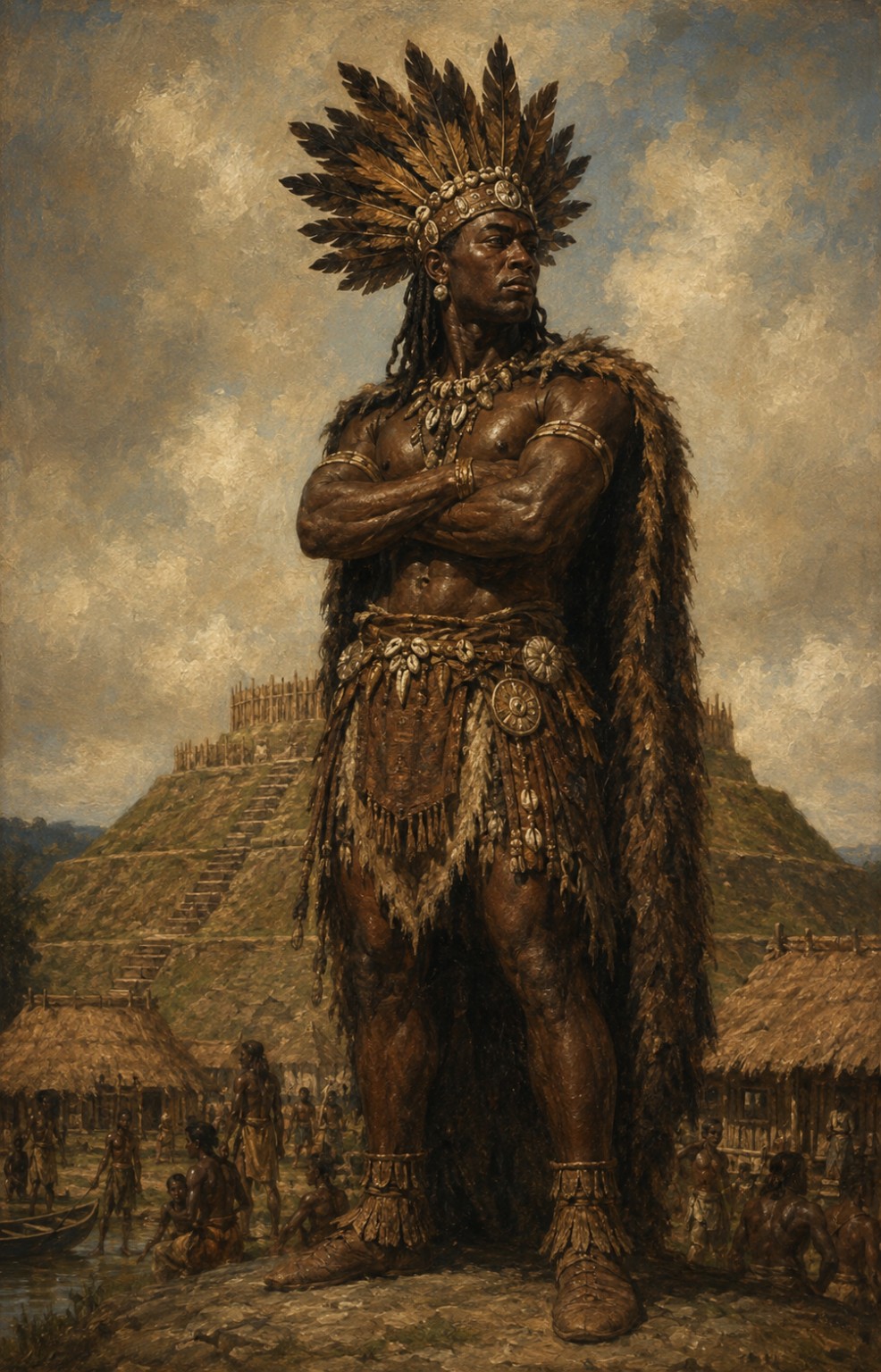
In 1540, Hernando de Soto's expedition entered the political world ruled by Tuskaloosa (also rendered Tascalusa/Tascaluza), a powerful Indigenous chief in what is now Alabama. The encounter culminated at the fortified town of Mabila in one of the expedition's largest battles.
Alabama historical sources give the name as tushka (“warrior”) + lusa (“black”). The Black Warrior River and Tuscaloosa preserve that name.
The translation alone does not establish what “black” signified about the man himself.
Early expedition testimony portrays Tascalusa as exceptionally large. Later retellings gave numerical height estimates, but those estimates are not the same as a contemporary measurement.
Tuskaloosa's world was part of the chiefdom-based Indigenous Southeast: agricultural communities, ceremonial centers, mound landscapes, fortified towns, trade and political alliances.
A 1971 Tuscaloosa local-history column called Tushkaloosa a “large swarthy Indian chief.” It is relevant to the history of how he was remembered, but it was written more than four centuries after 1540.
One reading treats the name as evidence of complexion. Other interpretations treat it as a title, status, symbolism, paint, or another naming convention. TK-001 keeps those possibilities separate from the literal translation.
Later local histories contain stories about unusually large remains and mounds. Such stories require a traceable excavation record, specimen, accession number, or other independent verification before being treated as archaeological evidence.
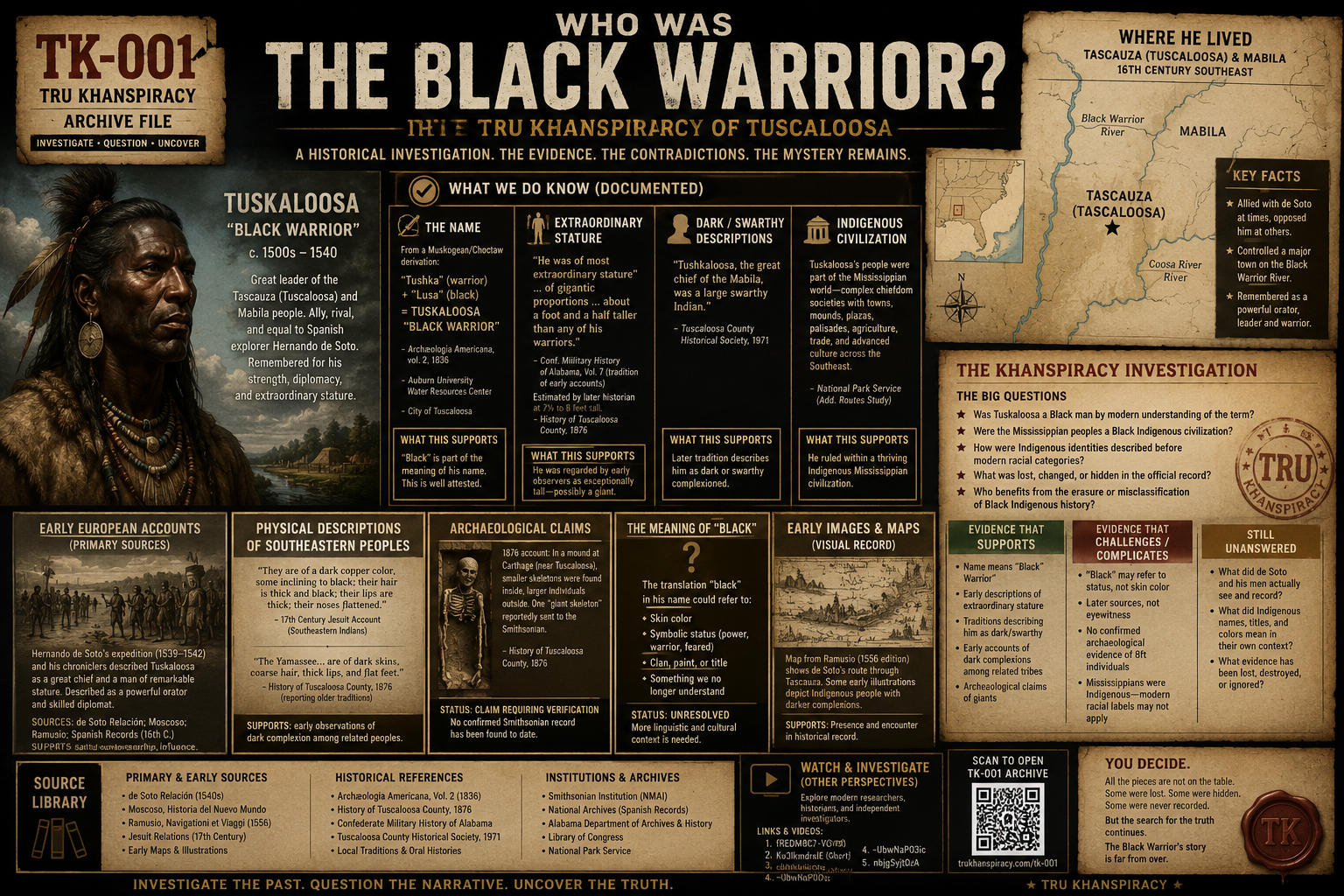
Tuskaloosa was a major Indigenous leader encountered by the de Soto expedition; his name is conventionally translated “Black Warrior”; accounts emphasize his imposing stature; Mabila became a devastating battle.
The surviving record gives real reasons to investigate how appearance, identity, translation, and later racial terminology shaped the story told about Tuskaloosa.
Exactly what “black” signified in the name; how contemporary observers described his complexion; and how later identity categories should—or should not—be projected backward onto the sixteenth century.
This interpretation reads the “Black Warrior” name together with later “swarthy” language and broader arguments about dark-complexioned Indigenous peoples. These clues can motivate investigation, but they do not by themselves establish Tuskaloosa's identity under a modern U.S. racial category.
This interpretation argues that “black” could have functioned as status, symbolism, a warrior designation, paint, or another cultural naming convention. It also cautions that modern racial categories do not map neatly onto sixteenth-century Southeastern identities.
The de Soto expedition was not a neutral sightseeing journey. National Park Service histories describe threats, hostage-taking, violence, theft and warfare during its passage through Indigenous communities. At Mabila, Tuskaloosa's people confronted the expedition in a fortified town. The exact location of Mabila remains unresolved.
Casualty estimates differ among historical accounts and modern summaries; TK-001 treats them as estimates rather than exact totals.
These videos were submitted for the research file. Inclusion is not endorsement. Compare each claim against the source library below.
Documented evidence is not the same thing as interpretation. A repeated story is not automatically a verified fact. A mystery is not automatically proof of a conspiracy.
FOLLOW THE EVIDENCE. COMPARE THE RECORDS. DECIDE WHAT REMAINS UNRESOLVED.